


WHAT EXACTLY IS WRONG WITH NIGERIAN FOOTBALL?? The controversy surrounding the Nigeria Football Federation’s decision to investigate the Super Falcons’ 2026 Women’s Africa Cup of Nations campaign has taken a surprising turn following the resignation of the chairman of the fact-finding committee, Ambassador Fanny I. Amun (MON).
The Ex-NFF Fact-Finding Committee Chairman has rejected the widespread criticism of Nigeria’s Super Falcons’ performance at the 2026 WAFCON in Morocco.
He declared the campaign a “huge success” while revealing deep concerns over;
- player release,
- preparation,
- camp management,
- technical decision-making and
- the administration of Nigerian football.
Amun, a former NFF Secretary General, Technical Director and coach of Nigeria’s national teams, spoke exclusively to Brila.net, after stepping down from his position, offering a detailed explanation of how the committee operated and why he strongly disagreed with the description of Nigeria’s Morocco campaign as “woeful.”
His position is strikingly different from the narrative that has dominated the aftermath of the tournament.
“I disagree with anyone who says the performance was woeful. The team’s performance in Morocco was a huge success.”“Teams left in the group stages and quarterfinals and semifinals.”
For Amun, the committee’s mandate was never simply to find somebody to blame.
Rather, he said it was established to uncover the facts behind Nigeria’s recent difficulties and identify structural problems affecting the country’s football system.

How the Fact-Finding Committee Began Its Work
According to Amun, the committee was given a specific modus operandi, including terms of reference that went far beyond the Super Falcons’ performance in Morocco.
Asked by Brila.net about the methodology used by the committee, Amun said:
“First and foremost, we’re given the modus operandi, and which include, but not limited to, the terms of reference.”“The terms of reference, you see the public notes, they say facts, facts with S, the plural, findings.”“And then I said, with WAFCON, as a reference.”
He subsequently questioned the manner in which the Super Falcons were being described in the wake of the tournament.
Amun argued that Nigeria’s football history and the achievements of the players should be considered before attaching negative labels to the team.
He said:
“When they say woeful, woeful, and I told you that from day one, a team that won 10 times, in Africa, 10 times, and qualified for the World Cup, every league, less than one year ago, he celebrated them, gave them $100,000 each.”“Calculate it in Naira, please.”
He continued:
“Gave them certificate of occupancy, of whether plot or house and national honour.”“I disagree with them in total.”‘You cannot tell me, I’m naive’
Amun also leaned heavily on his experience within Nigerian football while explaining why he resisted some of the descriptions and conclusions surrounding the Falcons.
He reminded listeners that he had occupied several of the most important technical and administrative positions in Nigerian football.
“I was a sole administrator. I was a secretary general. I was a technical director for seven years and I was a coach of all the national teams.”
“So you cannot tell me, I’m naive.”
According to Amun, his objection was not merely emotional.
He believed that the players should be recognised for what they had achieved rather than dismissed because of one tournament outcome.
“That word woeful, I said, please change it, and appreciate them, because Mali said, he who fights along the way, lives to fight another day.”
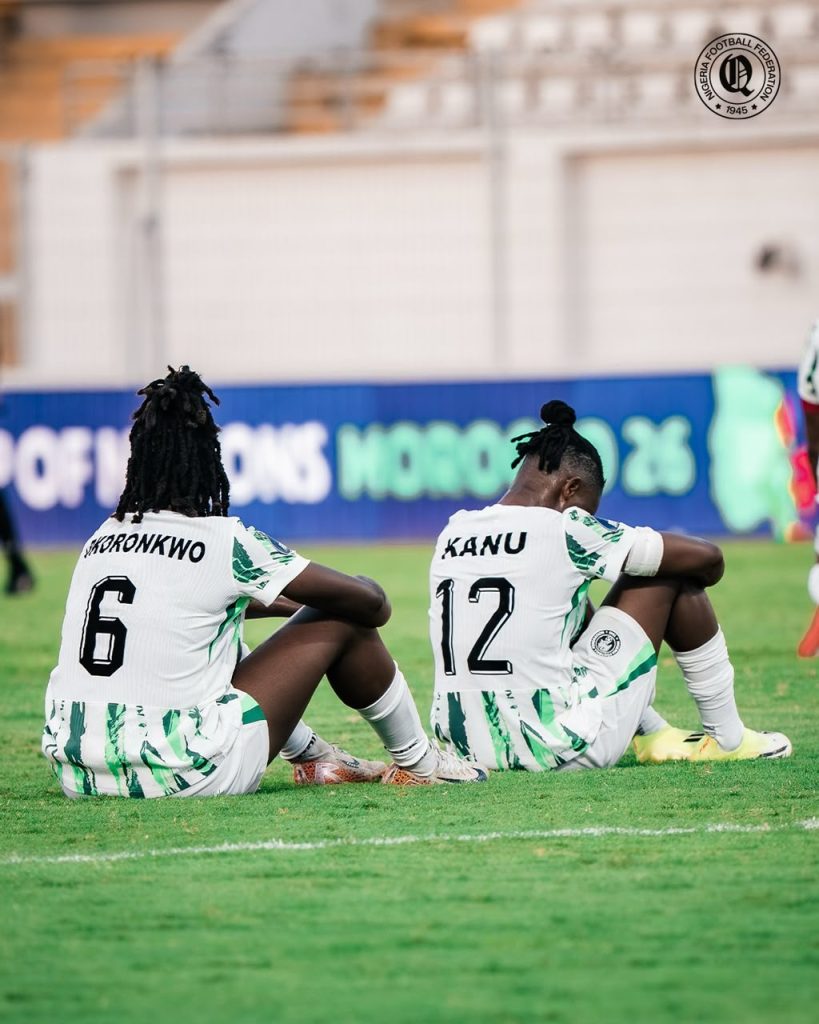
Amun’s Defence of the Morocco Campaign
The strongest part of Amun’s defence centred on the Super Falcons’ performance at the tournament in Morocco.
Rather than viewing the outcome solely through the prism of Nigeria’s expectations, he argued that other teams had already been eliminated at different stages of the competition.
“The success in WAFCON Morocco was a huge success. I challenge anybody, anybody.”“Teams left at the group stages.”
He continued:
“Teams left at the quarterfinals. They didn’t make the semifinals. I agree.”
However, Amun was careful to distinguish between defending the result and ignoring the problems that affected the team’s preparations.
“I’m not telling you, that I support what would have happened, but I’m not asking what were the challenges.”
That distinction is central to the fact-finding report, which examined issues ranging from
- player availability and injuries to preparation,
- technical management,
- administration, finances and
- governance.
Player Release and Late Arrival Became Major Issues
One of the significant issues raised during the committee’s work was the availability of players and the timing of their arrival in camp.
Amun said the coaches told the committee that a significant number of the players were based abroad and that the camp was called early.
“The coaches, they said a lot of their players are based abroad. And they called the camp much earlier.”“Nobody came.”
According to Amun, the situation eventually affected what could realistically be achieved during preparations.
“The Alliance finally matched it. It was not possible to implement it.”
The committee therefore considered whether alternative players should have been utilised.
Amun explained:
“And I said, why don’t you bring them? You said you will not play abroad. They said yes.”
He further stated:
“Delay of issuing Visa. I said if I were you, I would play with boys.”
He believed the same standard of competitive preparation could still have been achieved.
“The same level of performance we want to have with Chinese national team. You can have it with those guys playing with boys It was stronger.”

Amun: Visa Delays Were Not Automatically the NFF’s Fault
The former NFF official also addressed one of the contentious issues surrounding the team’s preparation: the timing of players’ departures for Morocco.
Amun insisted that responsibility for visa-related delays should be carefully assigned rather than automatically placed at the feet of the NFF.
“Yes, the issue of performance, departure, is not that of NFF.”#“No, please.”
He explained that when a country agrees to host an international tournament, certain responsibilities and conditions are involved.
“When a country wants to host such a tournament or championship, they are agreeing.”
“Then there’s acceptance to host with many conditions, which include but not limited to security and visa applications granted.”
According to Amun, once the host country fulfils its visa obligations, subsequent delays caused by travelling delegations may not necessarily be the responsibility of the football federation.
“Then if the host country, like Morocco, now issues the visas to all their embassies and they now decide to depart late, it’s not the NFF.”
He went further, suggesting that delays could sometimes be deliberate.
“Some countries might even do it intentionally.”
“Delay, delay, delay, delay.”
Amun believes that delays can occasionally produce an unexpected benefit.
“Sometimes it’s a blessing in disguise. So that’s one that they refuse to know.”

The Coach and the Responsibility to Find Solutions
Amun also placed considerable emphasis on the relationship between the technical team and the federation.
According to him, there was a disagreement over whether the team should use available younger players during the preparation period.
He then placed greater responsibility on the coach.
“They didn’t accept that they have to play with male in the fourth of the NFF.”“And the coach, but more of the coach, because the coach never told us they agreed for them to camp them.”
Amun argued that the NFF’s role is primarily administrative, while coaches are expected to make technical recommendations.
“They told us that they agreed for them to move, but he did not know that he himself was supposed to even suggest it to NFF.”“NFF is administrative. You are the coach.”
For Amun, technical officials must take ownership of technical problems.
“Then I say, okay, you take care of the problem. Take care of the opponent, they don’t know what they do there. They don’t know.”

Questions Over How National Team Coaches Are Supported
The former committee chairman also raised concerns about the broader system used to recruit, support and monitor coaches.
He argued that technical officials can sometimes be unfairly blamed when decisions concerning national team personnel are made elsewhere.
“You don’t blame them, because nobody asks questions.”
Amun gave an example of how discussions around the recruitment of coaches could become politicised.
“For instance, if you say they want to recruit coaches, they’ll make up maybe the last five coaches.”“They will turn it against the technical department and put their coaches of choice.”
He also suggested that some officials were not sufficiently involved in understanding the preparation and participation of teams.
“I will tell you why. They were not even aware, taking a long about their training or their participation.”
He recalled an occasion when he contacted a coach and discovered that the coach was not even with the team.
“Sometimes when they are playing tournament anyway, I’ll call the coach, he’ll say, he’s in Benin.”
Amun said he questioned the coach:
“I’ll say, why? He’ll say they didn’t take him.”
He referred to another tournament:
“Up to the one they played in Abeokuta. Abeokuta is in Nigeria.”
He then questioned the inclusion of technical leadership in team operations:
“His name was not… If you list names of players and officials, one of the top technical officials is who?”“Is the technical director or his department.”“So please, if the coach,if the technical director said he was not aware,nobody took him along.”
What the Official Fact-Finding Report Found
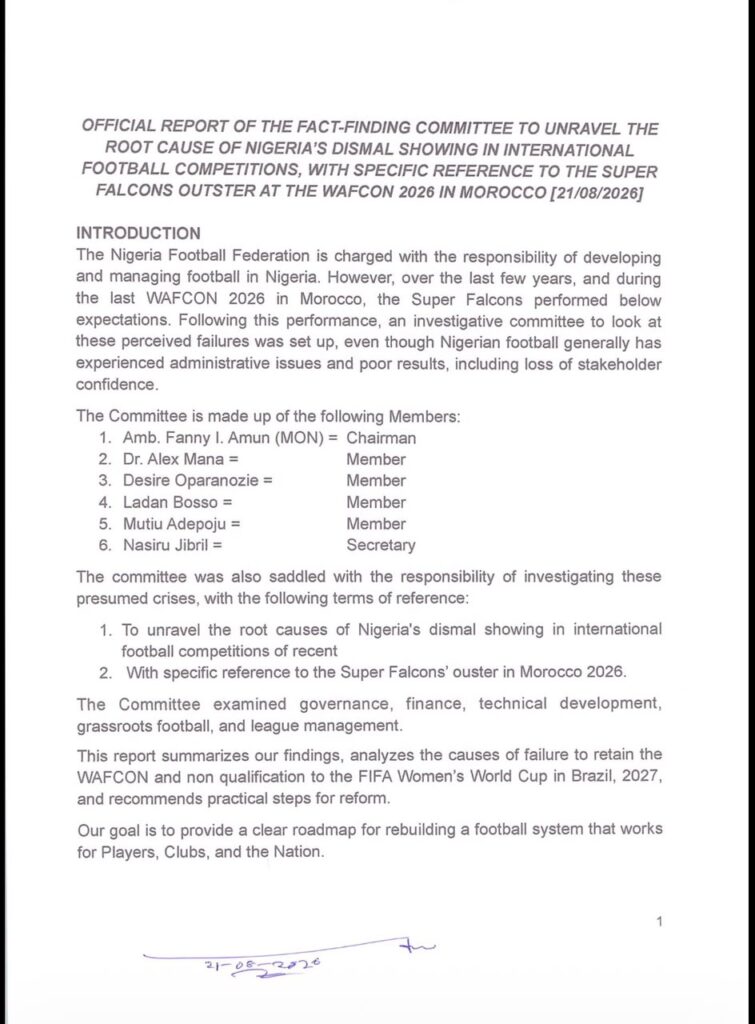
The committee’s official report, dated 21 August 2026 in Abuja, provides a much broader picture of the issues examined.
Titled
“Official Report of the Fact-Finding Committee to Unravel the Root Cause of Nigeria’s Dismal Showing in International Football Competitions, With Specific Reference to the Super Falcons Outster at the WAFCON 2026 in Morocco,”
the document said the NFF had a responsibility to develop and manage football in Nigeria but noted that Nigerian football had experienced administrative challenges, poor results and a loss of stakeholder confidence.
The committee was made up of:
- Amb. Fanny I. Amun (MON) — Chairman
- Dr. Alex Mana — Member
- Desire Oparanozie — Member
- Ladan Bosso — Member
- Mutiu Adepoju — Member
- Nasiru Jibril — Secretary
Its terms of reference were to investigate the root causes of Nigeria’s recent poor showing in international competitions, with specific reference to the Super Falcons’ campaign in Morocco.
The committee examined governance, finance, technical development, grassroots football and league management, while also looking at the circumstances surrounding Nigeria’s failure to retain the WAFCON title and its failure to qualify for the 2027 FIFA Women’s World Cup in Brazil.
The stated objective was to provide a roadmap for rebuilding a football system that works for players, clubs and the nation.

Player Injuries: Plumptre’s Case Examined
One of the report’s findings concerned player injuries, with the committee specifically examining the case of Ashleigh Plumptre.
The report stated that Plumptre had undergone surgery and was not fit to play.
According to the committee, this was corroborated by medical personnel both in Nigeria and at her foreign club.
The committee therefore did not find the player’s absence to be a straightforward selection controversy.
It also reported that players were generally cooperating with one another and that there was no finding of individual player influence over team selection.

Camp Management Came Under Scrutiny
Although the committee found no alleged player influence over selection, it raised concerns about how officials interacted with the team camp.
The report stated:
“The committee didn’t agree with the whole process of how some officials infiltrated the camp at will.”
The report recommended that issues involving player loyalty, performance and team management be streamlined through the technical department and handled by the appropriate heads.
It also called for the federation to establish a deliberate template for team management and player development.

A Long List of Structural Problems
The committee’s findings went well beyond the Super Falcons.
Among its recommendations and areas of concern were:
- Better coordination of player release and communication.
- Clearer hierarchy between analysts and the technical team.
- Structured management of player injuries and fitness.
- Better player availability and earlier camp preparation.
- Stronger camp rules and administration.
- Deliberate plans for both male and female football.
- Training and retraining of administrative and technical staff.
- Better age verification and player data systems.
- Stronger regulations and oversight.
- Increased use of technology to attract funding.
- Greater support for the women’s football league.
- Restructuring government and corporate support.
- Better structures for the Nigeria National League.
- Improved coaching education and certification.
- Greater use of the Super Six tournament for national-team scouting and development.
- Early and coordinated preparation of national teams.
- Better structures for the NPFL, NNL, NLO and NWFL.
- Monitoring the negative influence of social media.
- Standardisation of remuneration and rewards.
- Selection based on physical fitness and performance indices.
- Greater technical support and expert input.
- Improved management of financial and compensation issues.
Governance and Financial Allegations
Perhaps the most sensitive portions of the report concerned allegations surrounding the wider administration of Nigerian football.
The committee referred to an alleged refusal by the NFF Congress to implement necessary and workable changes to the statutes, despite requests from three Presidents of the Federal Republic of Nigeria.
It also recommended that Congress members should be knowledgeable, credible and experienced personalities, with a maximum of two terms in office.
The report further listed allegations that some board members could influence the invitation of players to national teams, both locally and internationally.
– Another allegation concerned coaches and officials allegedly becoming involved in inviting players to national camps for the purpose of obtaining financial gains.
The report also highlighted claims that, within delegations containing players, coaches, NFF management staff and board members, board members and management staff were paid while players and their officials were not.
– There were also allegations that some board members, NFF management staff and coaches could take incentives to compromise decisions concerning national-team camp invitations.
Importantly, these were allegations recorded for investigation and reform purposes, not findings that the report itself established as proven facts.

‘Missing Money’ Incident in Morocco Also Mentioned
The committee also examined an incident involving missing money in Morocco.
Its recommendation was straightforward: issues of this nature should be managed at the highest level of leadership.
The report further connected social-media activity and external influence to team cohesion, arguing that negative effects should be closely monitored.
The Bigger Question: Was Morocco a Failure?
That is ultimately the question at the heart of the controversy.
The public debate has largely focused on whether Nigeria’s performance in Morocco represented failure.
Amun’s answer is emphatic: NO.
He believes the Falcons should be judged in context, particularly against the preparation difficulties surrounding the tournament.
His defence is not an argument that everything went perfectly. In fact, his own committee’s report identifies numerous problems requiring urgent attention.
Instead, Amun’s position is that the team’s tournament performance cannot be isolated from the circumstances surrounding it.
His argument is that Nigeria must distinguish between the performance of the players on the field and the structural failures that may have affected the team before and around the competition.
Spotlight Turns Back on Nigerian Football
The significance of the report therefore extends beyond the Super Falcons.
Its recommendations point towards a broader overhaul of Nigerian football, from the way players are invited to national camps to the way coaches are supported, from league structures to data management, from remuneration to governance.
The committee called for practical and implementable recommendations backed by political will.
Its final remarks stressed the need for internal organisational mechanisms capable of verifying facts and producing better outcomes from future federation programmes.
The report concluded that there was a need to focus on “diagnostic synergies” capable of repositioning and properly treating the areas it identified.
And despite the controversy, it made one final appeal:
“It is also very important to commend the team to Morocco and move ahead.”
Amun’s Exit Adds Another Twist
Amun’s resignation now adds another layer to a story that was already generating intense debate among Nigerian football stakeholders.
The former NFF official has made it clear that he does not believe the Super Falcons should carry the burden of the wider problems identified by the committee.
This suggests that the biggest battle may not be over what happened in Morocco, but over how Nigerian football is administered when the cameras are no longer watching.
The official report, signed by Amb. Fanny I. Amun (MON), Chairman, and Nasdru Jibril, Secretary, was dated 21 August 2026 in Abuja.
For Amun, the Falcons deserve criticism where criticism is justified, but the players should not be made scapegoats for problems that extend deep into the structure of Nigerian football.
And his challenge remains as direct as it was when he began defending the team:
“The success in World WUFU Morocco was a huge success. I challenge anybody, anybody.”
With the fact-finding report now on the table and its chairman publicly explaining his position, the conversation has shifted from “Who failed?” to a much bigger and more uncomfortable question:
“What exactly is wrong with Nigerian football and who is prepared to fix it?”